
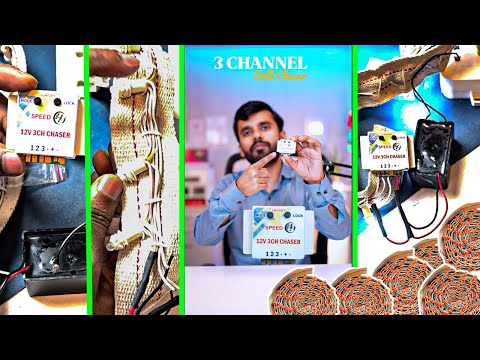
| Specification | Details |
|---|---|
| Channels | 3 output channels |
| Input Voltage | 12V DC |
| Compatible LEDs | 12V single-colour LED only — strip or 50-LED bunch (NOT pixel / WS2812 / 5V) |
| Capacity per Port | Max 5 bunches per port (~50W) |
| Full Load | 3 ports × 5 bunches = 15 bunches ≈ 150W |
| Recommended SMPS | 1 × 12V 400W (market SMPS under-rated; keep margin) |
| Output Wiring | ≥1.5 mm from SMPS; 1.5 mm common bus, thinner single taps |
| Modes | Manual & Auto chasing effects, Design Lock button |
| Output Switching | Transistor / MOSFET, negative (−ve) side — common positive type |
| Power Source | 12V SMPS or 12V battery |
| Setup | Plug and play — no software, no WiFi |
| Applications | Diwali, gate, Thoran, waterfall, sign board, LED strip running, DIY chaser |
| Warranty | 6 months* (manufacturing defects only) |
| Brand | Koshi Electronics |
12 Volt 3-Channel LED Chaser Controller
NOTE: This product works only with 12-Volt single-colour LEDs — strip or 50-LED bunch, both work. Not for pixel / WS2812 / 5V LEDs.
The Koshi Electronics 12V 3-Channel LED Chaser is a simple, reliable chasing controller for 12V single-colour LEDs. Manual and auto chasing effects, a design-lock button, and a maximum of 5 bunches per port. Plug-and-play — no software, no WiFi.
Live Demo
Key Features
- 3-Channel Output — sequential chasing on 12V single-colour LEDs (strip or bunch)
- Manual & Auto Chasing + Design Lock Button
- Max 5 Bunches per Port (~50W/port)
- Negative (Common-Positive) Output — transistor / MOSFET negative-side switching
- 12V DC — runs from a 12V SMPS or 12V battery
Perfect For
- Diwali, Navratri, Ganpati (Ganesh Chaturthi), festival and gate decoration
- Waterfall effect and sign-board lighting
- LED strip running, shop fronts and signboards
- Building your own LED chaser (DIY) and college projects
Power & SMPS
Each port handles a maximum of 5 bunches (~50W). The full load across 3 ports is ~15 bunches ≈ 150W. Recommended: 1 × 12V 400W SMPS. (Cheap market SMPS are usually under-rated, so keep a little margin.)
Complete Your Setup
- 12V Single-Colour LED (strip or 50-LED bunch) — see all options: 12V Single Colour LED Collection. Popular: Copper SMD LED String (50 LED Bunch)
- 12V 400W SMPS — 12V 400W Rainproof Heavy Duty SMPS
How To Set Up (Wiring)
- Connect the chaser's power input to a 12V SMPS or 12V battery (VCC = +ve, GND = −ve).
- Common all LED POSITIVE (+ve) wires together and connect them directly to the power supply +ve terminal.
- Connect each LED line's NEGATIVE (−ve) wire to the chaser's 3 output channels in sequence (1, 2, 3). The outputs switch on the negative side, so the positive stays common.
- Wire gauge: at least 1.5 mm wire from the SMPS output; with ~1-foot bunch spacing a 1.5 mm common bus is fine, and single tap wires can be thinner.
- Power on — in Auto mode chasing runs automatically; in Manual mode adjust it yourself. Press Design Lock to hold a pattern.
Warranty
6-Month Warranty* against manufacturing defects only (controller board).
*Not covered: physical damage, water damage, wrong SMPS connection (reverse +/− polarity), connecting LEDs directly to 220V AC, or the controller/SMPS exposed to rain. Protect the controller and SMPS from rain — the LEDs themselves are waterproof.